
Powered By


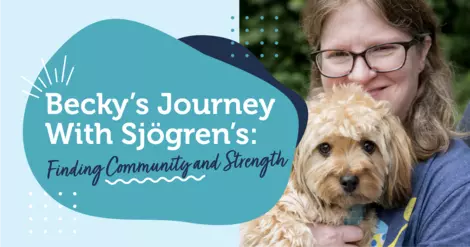
Before Becky Hosey developed severe symptoms at age 37, her life was busy. She was a healthcare provider and the parent of a 5-year-old. She had years of clinical experience as both a licensed physician assistant and a chiropractor.
“I fell very sick very quickly, and I didn’t quite understand what was happening,” Becky said.
She was diagnosed with Sjögren’s disease in 2015 and stage 4 endometriosis in 2021. Sjögren’s affected nearly every part of her life, including her work, family life, and sense of self.
Eventually, Becky stopped working in clinical care. “I have stopped working clinically at this point, which was very, very hard for me, but I just wasn’t able to do that on a regular basis anymore,” she said.
3 Ways I Stay Positive With Sjögren’s
Becky shares how Sjögren’s changed her life and inspired her to become a patient advocate.
00:00:00:00 - 00:00:28:13
Becky Hosey
What I wish I knew about Sjögren’s when I was first diagnosed was how impactful this would be in every aspect. How deep into every nook and cranny of my life. So my career, my family, myself. I’ve changed completely as a person. I was a busy healthcare provider, a mom of a five-year-old, and at 37, I fell very sick very quickly and I didn’t quite understand what was happening.
00:00:28:15 - 00:00:51:07
Becky Hosey
I was trying to kind of balance family, work and self-care, which was quite challenging. I have stopped working clinically, which was very, very hard for me, but I just wasn't able to do that on a regular basis anymore. This advocacy career, I mean, it just kind of fell into my lap. My diagnosis journey to Sjögren’s was a constant fight.
00:00:51:07 - 00:01:12:22
Becky Hosey
It was a battle. I had an epiphany and realized that if I go into a room of, say, like 100 healthcare providers or students of medicine, even if just a handful of these professionals were touched by my story, that's way more impactful than if I could just see patients 40 hours a week. I actually came up with this concept.
00:01:12:22 - 00:01:36:06
Becky Hosey
I cut up a white coat that I had and a patient gown, and I sewed them together. I put on this coat so that the audience members can understand like I am one of them. I am a healthcare provider who wears this white coat, but I'm also a patient who wears this patient gown and is very vulnerable. How I stay positive with Sjögren’s is that I am grateful for everything.
00:01:36:06 - 00:02:01:21
Becky Hosey
I have an appreciation for the small things, to the big things, and everything in between that I didn't have prior. If I didn't have Sjögren’s, I would have missed so much of my son’s growing up. He's 16 now. I was able to be the classroom mom and go to all those events and such, so I was able to have this time with my family that I would have never had.
00:02:01:22 - 00:02:29:01
Becky Hosey
So looking at the positives, I feel like I have such an understanding of others and with myself. This is a complex illness. There are gaps in medical knowledge, but there are some great things on the horizon. New research has brought new medications which are soon to be available and therefore a new chapter for us all. Never give up.
00:02:29:03 - 00:02:33:21
Becky Hosey
Keep pushing forward. Learn more and connect at MySjögrensTeam.com.
Becky’s experience seeking medical care changed her perspective as a healthcare professional. She said her journey to a Sjögren’s diagnosis was long and intense, and the barriers she faced helped inspire her advocacy work.

Becky began sharing her story at educational institutions and professional conferences. Her advocacy also took her to Washington, D.C., and legislative meetings in New York.
She came to see advocacy as another way to make an impact. “I had an epiphany and realized that if I go into a room of, say, a hundred healthcare providers or students of medicine and I share [my diagnosis journey] ... even if just a handful of these professionals were touched by my story, that’s way more impactful than if I could just see patients 40 hours a week.”
Becky’s health challenges changed her career, but they also changed how she looked at everyday life. “How I stay positive with Sjögren’s is that I am grateful for everything. I have an appreciation for the small things to the big things and everything in between that I didn’t have prior,” she said.
Working less also gave Becky more time with her son. She said she was able to visit his classrooms, take part in school activities, and attend events she might have missed while working full time in clinical care.
Becky didn’t ignore the challenges Sjögren’s brought. Instead, she tried to recognize the positive changes that came with a different pace of life.
“So looking at the positives, again, I feel like I’m definitely a better person. I feel like I have such an understanding of others and of myself,” she said.
Get updates directly to your inbox.




 Continue with Facebook
Continue with Email
Continue with Facebook
Continue with Email

 Join

 Your Privacy Choices

This is a member-feature!
Sign up for free to view article comments.
We'd love to hear from you! Please share your name and email to post and read comments.
You'll also get the latest articles directly to your inbox.